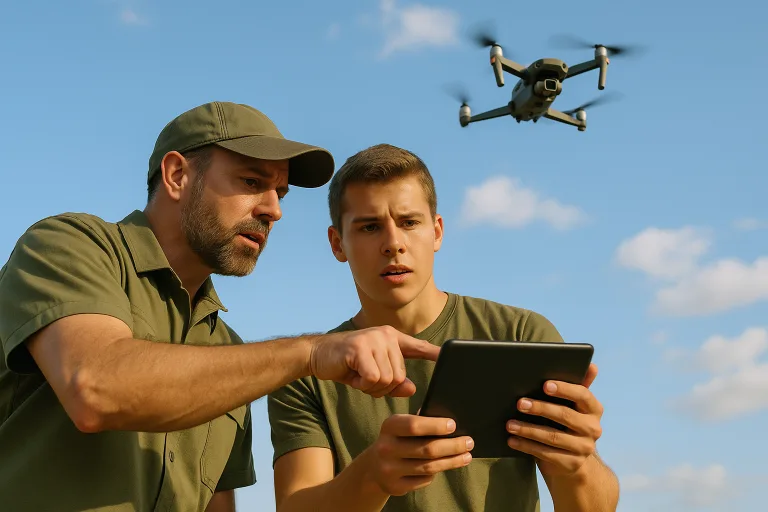
Why Novokuznetsk Needs Professional Drone Training
Novokuznetsk and the greater Kuzbass region are hubs of heavy industry, mining and infrastructure development — sectors where unmanned aerial vehicles (UAVs) deliver clear operational and economic value. Professional drone operator training and qualified UAV instructors are essential to ensure safe, legal and efficient deployments for surveying, inspections, emergency response and mapping.
*Investing in structured training reduces accident risk, ensures regulatory compliance and unlocks advanced commercial applications across the region.*
Core Components of a Modern Drone Operator Program
A comprehensive curriculum balances theory, practical flight skills and mission-specific competencies.
— Theoretical foundations
— Aviation fundamentals and basic aerodynamics
— National and regional UAV regulations — how to check and comply with current Rosaviatsiya and municipal rules
— Airspace classification, NOTAMs and coordination with airports and air traffic services
— Meteorology and local weather considerations (seasonal winds, low temperatures, visibility and industrial emissions)
— Privacy, data protection and ethical operation
— Practical flight training
— Progressive hands-on practice: basic maneuvers → automated missions → complex scenarios
— Simulator sessions to reinforce procedures and manage abnormal situations
— Emergency procedures: lost link, flyaway prevention, safe landing and contingency planning
— Payload operation: photogrammetry, thermal imaging, LiDAR basics and sensor calibration
— Maintenance, pre-flight checks and post-flight inspections
— Mission planning and operations
— Risk assessment and safety management (briefings, checklists)
— Flight planning tools, mission logging and data workflows
— Crew resource management for BVLOS or multi-operator missions where permitted
— Reporting, documentation and asset management
Instructor Education: Building Quality Trainers
Good instructors are more than expert pilots — they are teachers, assessors and safety champions.
— Teaching and assessment skills
— Adult learning techniques, structured lesson planning, and scenario-based training design
— Objective assessment methods: practical checkrides, scenario performance, and knowledge exams
— Use of simulators and debriefing techniques to accelerate learning
— Instructor-specific competencies
— Advanced flight demonstrations and safety-of-flight judgment
— Curriculum adaptation for industry-specific use (mining, industrial inspection, agriculture)
— Developing and maintaining a training syllabus aligned with national standards and employer needs
— Quality assurance and continuous development
— Proficiency currency standards, recurrent training and incident review processes
— Peer review, mentorship and instructor shadowing programs
— Keeping up with evolving regulations, airspace tools and UAV technologies
Local Considerations for Novokuznetsk
— Weather and seasons: Winter temperatures and snow require cold-weather operational planning and battery management procedures.
— Industrial environment: Emissions and complex infrastructure call for careful pre-flight risk assessments and sensor-cleaning protocols.
— Airspace and coordination: Coordinate with Spichenkovo airport and local air traffic authorities before conducting flights near urban or industrial zones.
— Missions in demand locally: structural and plant inspections, mine mapping, environmental monitoring, construction progress documentation, and emergency services support.
Typical Course Formats and Duration
— Beginner courses: introductory theory + basic flight skills — good for hobbyists and first-time operators.
— Commercial operator programs: in-depth theory, mission planning and 20–60+ hours of supervised flight practice (format varies by provider and student pace).
— Instructor certification: candidate selection, pedagogy modules, supervised teaching practice and formal assessment.
(Exact hours and certification requirements change over time — check current national and regional regulations and accredited program syllabi.)
Equipment Recommendations for Training
— Entry-level trainers: robust, easy-to-repair multirotors for basics and dual-control capability.
— Intermediate/advanced platforms: prosumer models with autopilot, RTK-capable mapping drones and payload options (RGB, thermal).
— Simulators and training software: essential for scenario practice and emergency procedure rehearsal.
— Maintenance tools: battery thermal management systems, spare parts, prop guards and calibrated payload testers.
Safety, Legal and Insurance Essentials
— Always verify registration and insurance requirements for commercial operations.
— Maintain line-of-sight unless specific approvals are granted; respect privacy laws and property rights.
— Implement documented safety management systems: pre-flight checklists, incident reporting and corrective actions.
— Use geo-awareness apps and official sources for airspace restrictions and temporary flight zones.
Career Paths and Industry Opportunities in Novokuznetsk
— Industrial inspection and maintenance (steel plants, conveyor systems, pipelines)
— Surveying and GIS for mining and construction projects
— Agriculture and land management in the Kuzbass region
— Emergency response, search and rescue support and environmental monitoring
— Training and consultancy services for local businesses
How to Choose a Training Provider
— Verify accreditation and alignment with national standards
— Look for a balanced program: classroom