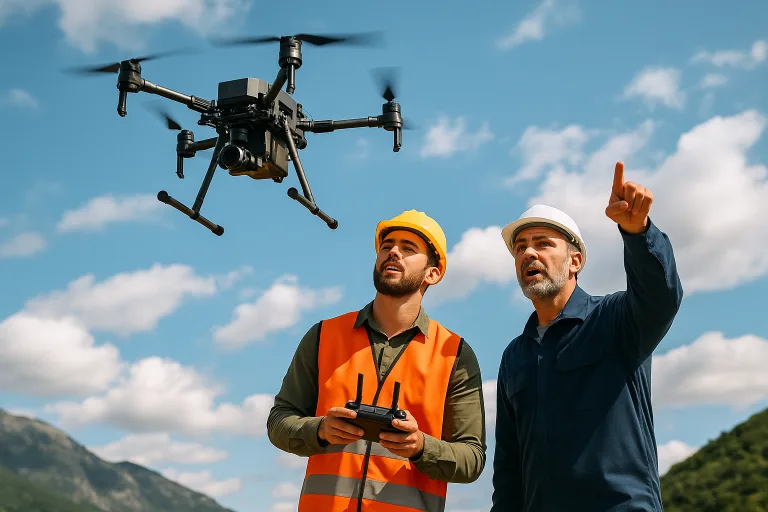
Introduction
Novokuznetsk — the industrial heart of the Kuzbass region — is seeing growing demand for skilled drone operators and qualified UAV instructors. From mining and metallurgy inspections to environmental monitoring and emergency response, unmanned aerial systems (UAS) are becoming indispensable. This article outlines how robust training programs and instructor education can meet local needs and create sustainable career pathways.
Why Novokuznetsk Needs Drone Training
— Industry fit: Local mining, steel production, forestry and infrastructure sectors benefit from aerial surveying, equipment inspection and thermal imaging.
— Public safety and environment: Drones accelerate emergency response, search-and-rescue, and environmental monitoring across the Kuzbass territories.
— Workforce development: Modernizing technical skills helps local professionals diversify careers and supports small businesses offering drone services.
Core Components of a Drone Operator Training Program
A comprehensive course balances theory, hands-on practice and regulatory compliance:
— *Aviation fundamentals*: Airspace structure, meteorology basics, human factors and safety culture.
— *Regulations and compliance*: National civil aviation rules, local permitting, data protection and privacy considerations.
— *Flight training*: Simulator work, takeoff/landing practice, controlled scenario flights and mission planning (daytime, visual line-of-sight operations).
— *Payloads and sensors*: Practical use of cameras, LiDAR, multispectral sensors and thermal imagers for inspection and survey tasks.
— *Data processing and analysis*: Photogrammetry, orthomosaic creation, basic GIS workflows and reporting.
— *Maintenance and preflight checks*: Routine inspection, battery and component care, and logging for operational safety.
— *Risk management*: Identifying hazards, emergency procedures and insurance basics.
Educating UAV Instructors: Train-the-Trainer Essentials
High-quality instruction multiplies impact. A robust instructor education program should include:
— *Pedagogy and adult learning*: Lesson planning, assessment design, classroom management, and adapting training to diverse learners.
— *Standardization and curriculum design*: Aligning course content with national standards and industry needs.
— *Mentored practice*: Supervised teaching hours, peer review, and feedback loops to refine instructional techniques.
— *Assessment and certification*: Objective criteria for evaluating trainee competence and instructor readiness.
— *Continual professional development*: Keeping instructors current with advancing technologies, regulations and best practices.
Accreditation, Certification and Legal Considerations
— Align training with applicable Russian civil aviation and regional regulations to ensure graduates can operate legally and commercially.
— Offer verifiable certificates of completion; where possible, coordinate with local authorities or industry partners to recognize qualifications.
— Include modules on data protection and ethical use to address privacy concerns and community acceptance.
Facilities, Equipment and Partnerships
— Training venues should combine classroom space, controlled flight areas and simulation equipment.
— Recommended equipment mix: trainer-grade multi-rotors, inspection platforms, payload kits (camera/thermal), and photogrammetry-capable platforms.
— Forge partnerships with local industry (mining, utilities), emergency services and technical colleges to provide real-world project work and job placements.
Career Paths and Local Opportunities
— Inspection & maintenance for industrial plants, power lines and chimneys.
— Surveying and mapping for construction, land management and forestry.
— Agriculture/forestry monitoring and environmental assessment.
— Emergency response support and public safety applications.
— Entrepreneurship: creating local drone service companies or consulting practices.
Community and Economic Benefits
— Safer, faster inspections reduce downtime and occupational risk.
— Enhanced environmental monitoring supports sustainable resource management.
— New technical training creates jobs and retains talent within Novokuznetsk and the broader Kuzbass region.
Marketing a Local Training Program
— Highlight industry-relevant outcomes: inspection, surveying, and emergency-response competencies.
— Showcase partnerships, hands-on components and instructor credentials.
— Offer modular courses (introductory, advanced, instructor certification) to attract a wide audience.
— Provide case studies and testimonials from local businesses and first graduates.
Measuring Success
Track outcomes such as:
— Number of certified operators and instructors.
— Employment and contract placement rates post-certification.
— Industry partnerships established and projects completed.
— Safety records and incident reduction tied to trained personnel.
Conclusion
Investing in well-structured drone operator courses and rigorous UAV instructor education in Novokuznetsk aligns technical training with regional industrial needs. With sound curriculum design, regulatory alignment and strong local partnerships, such programs can drive economic value, enhance safety and prepare a new generation of aviation professionals for the skies above Kuzbass.
If you’d like, I can draft a sample curriculum outline, a marketing blurb for a local training center, or a checklist for setting up training facilities in Novokuznetsk.